
A European industrial footprint designed as a system
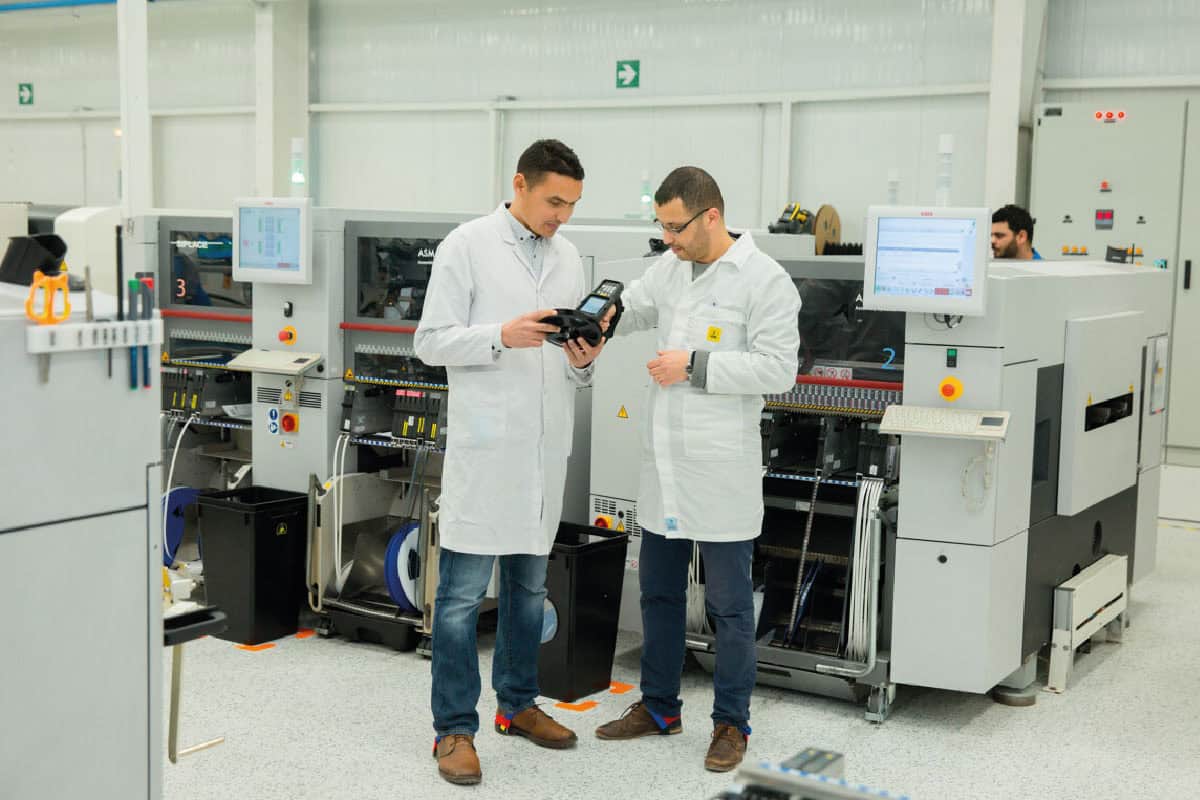
LACROIX has built a European industrial footprint designed not as a simple juxtaposition of sites, but as a coherent and structured whole, where each location plays a clearly defined role.
- France is its strategic backbone: it concentrates high value-added activities—Defense, Aeronautics, Industry—and embodies the ability to manage diversity, from prototyping to high-volume production.
- Germany extends this level of excellence in highly technical industrial environments, with a specialization in high-mix, low-volume production.
- Poland represents a key competitiveness lever for mass markets, particularly in Automotive and HBAS, with strong industrial capabilities for high-volume production.
- Tunisia, in close proximity to Europe, completes this setup by providing flexibility and competitiveness for high-volume production with controlled mix.
Complementarity as an architecture
The strength of the LACROIX model lies in a concept that is both simple and powerful: turning the specialization and specificities of each site into a performance multiplier for the others.
This complementarity makes it possible to:
- allocate each production to the most suitable industrial environment,
- continuously optimize the balance between proximity, complexity, and cost,
- and ensure structural agility, capable of absorbing market evolutions.
This is not a network, but an integrated industrial architecture, designed as such from the outset.
Unified governance, a guarantee of high standards
While execution is European, governance remains unified. One single player, one single level of requirement, one single reference framework.
This centralized governance ensures:
- consistency in industrial decision-making,
- consistency of production standards,
- and the uniform deployment of this French signature across all sites.
This is what makes it possible to reconcile geographical dispersion with full control over quality.
Critical size: a condition for sustainability
At the crossroads of resilience, competitiveness, and sovereignty challenges, the LACROIX model defines a path: that of a structured, governed, and demanding European industry.
But this ambition is built on a demanding balance.
Critical size is the driving force that makes it possible to sustain investment levels, preserve skills, and continue, over the long term, to uphold a certain vision of industry: demanding, controlled, and deeply European — with a distinctive French signature.